Thursday, January 24, 2013

Tsurugaoka Hachimangu

After checking out big Buddha we took the train back to Kamakura to visit the region's most important Shinto shrine.  On our way to the shrine we walked through Kawaguchi Street, which is a large shopping avenue that is closed to cars.  Elise and I went back later to pick up some souvenirs there.

As for Tsurugaoka Hachimangu, I'm not sure how big the grounds actually were, but I would estimate three or four acres.  The grounds included the honden (main hall) as well as many smaller shrines, two large ponds, smaller ponds and a few gardens.  Leading up to the shrine is a large walkway that is lined with paper lanterns.  This walkway also has many torii gates (pictured below).  Torii gates are used to designate the approach or entrance of a Shinto shrine; since Shintoism is one of Japan's largest and oldest religions we saw many others across the Kanto region.

Walkway leading up to the shrine.

Torii gate at the end of the walkway looking onto the grounds.

This is a stage in the central courtyard area; these can be used for
performances but we didn't catch one.

The honden and haiden or the main and offering halls.

Visitors making prayers and offerings.

We got lucky and were present when they came out to hit the drum;
we have no idea what it was for.

This is an 'ema'  where visitors leave their wishes on the wooden plates.
A few were written in (poor) English and was usually stuff about school or success.

This is a collection of omikuji, which are fortune telling strips.
An omiji is drawn at random per individual; I just now learned about what this actually is so we did not partake (nor do I know if it would have been frowned upon for us to do so).  This strip is then tied to a tree to bring the good luck true or to avert the bad luck; maybe some of the ema strips were to cancel out the bad lucks.

A Komainu is a guardian of the shrine.  They are usually in pairs
and are dogs or lions.  This ones pair is across the walkway. 

Another purification trough (as I have now learned they are called).

As for use of purification troughs - one is to wash hands and mouth before approaching the main hall.  It seems that they were placed more frequently than just that, so the practice may hold for approaching any of the lesser halls that were on the grounds.

We were there in the late afternoon so I caught a shot of hawks
during the evening hunt.  The eight here are less than half of what we saw.

Lexie gazing across the pond and looking at the fish.

A shot of Elise and I on a bridge over one of the 'ponds'.

I still don't know what all of these banners are for, but the bridge is neat.

A couple of shots of the sun coming through the entrance torii.


n.b.: as always, the pictures can be expanded by clicking on them

Friday, January 18, 2013

Hase Giant Buddha

Another short train ride from the Kamakura station took us to nearby Hase, home of the 'Great Buddha of Kamakura', also known as the Amida Buddha.  This Buddha statue is 13.35 meters (over 40') tall making it the second tallest in Japan.  It was originally built in the 13 century and placed indoors in a temple.  Since 1495 it has been outside, because this temple was hit multiple times by typhoons and tidal waves in the 14th and 15th centuries.

Our tickets to enter the grounds.

These washing basins were in temples and shrines everywhere.
I'm not totally sure what they are for (some cleaning I conjecture), but
I decided to try it.


A look at Amida Buddha from far away - you can get a sense of its imposing size.

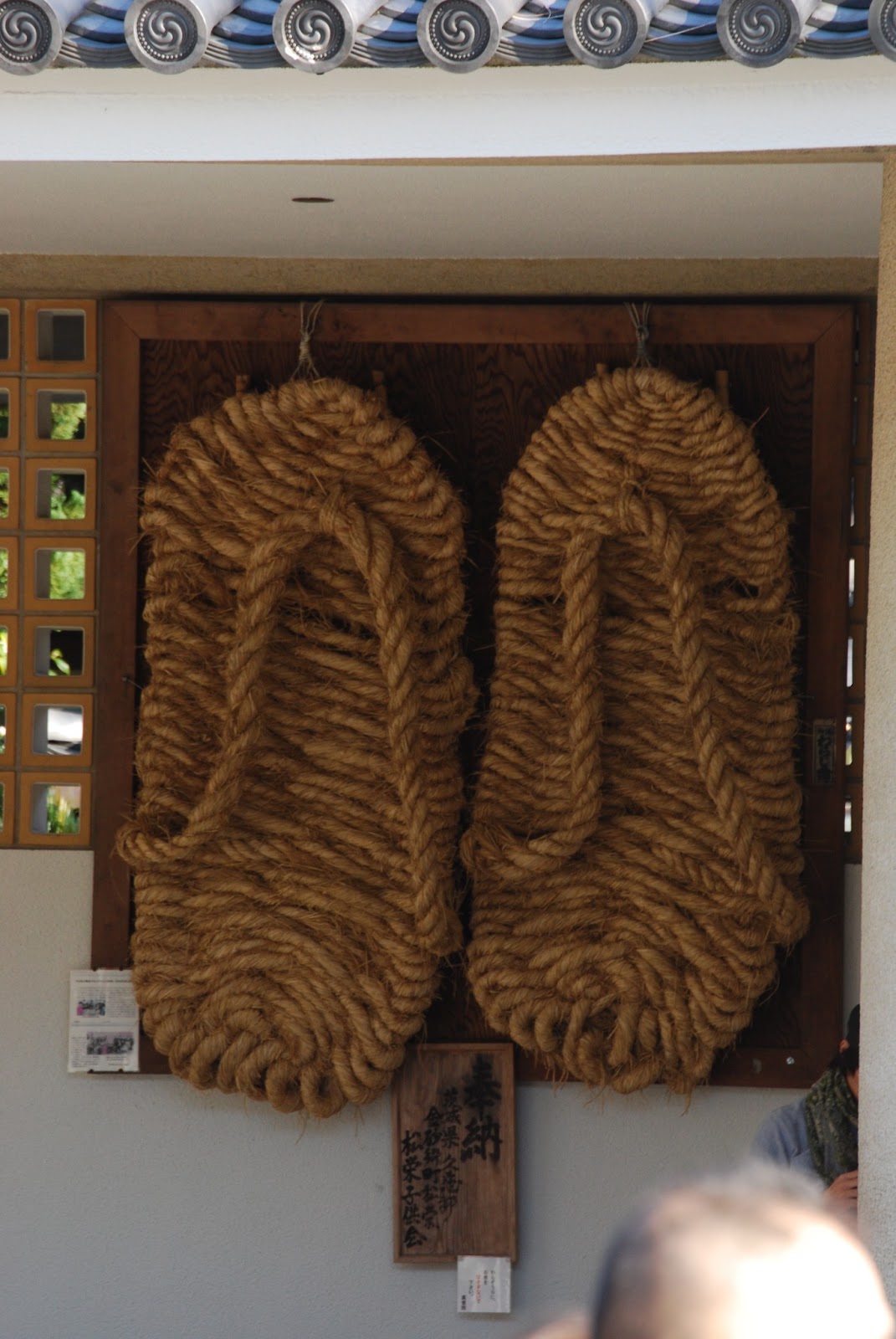
Big man... big feet.

A picture of us in front of the Buddha.

A small dedication area at his pedestal.

Incense burning offering at the base.

Lexie kept saying he looked sad.

The inside is hollow; for the equivalent of roughly a quarter you can go inside.

Mike and I reading about the construction while exploring the inside.

A memorial of an influential Buddhist associated with Hase Buddha.


Erika, Lexie and Elise.

The Grimstead family.

Verny Park

Our first full day in Japan was spent trying to retrieve my suitcase from the airport because in my travel delusion I had grabbed a suitcase that looked very similar to mine but had very different contents.  What should have been (at least what they told us would be) a few minutes at the airport became much longer.  Elise and I spent sometime behind closed custom doors with our passports taken from us.  My sister was almost to the point of contacting 'people' worried that we were being detained.  Enough of that.

On our first day really seeing Japan, we visited the Navy base and then took a train to nearby Kamakura (I think I took the train to Kamakura about 5 times during the trip).  Just to be clear, I love Japan's train system and public transportation; the ease to get just about everywhere with a short walk and a train ride was beneficial as a tourist.  Walking from the navy base to the nearby train station took us through Verny Park.  From the park we could see the shipyard and harbor; Lexie got to terrorize the park's pigeons by chasing them everywhere.

A beautiful place to drop anchor.


The harbor is shared by US and Japanese Ships

Lexie Enjoying the fountain with her Aunt E-lise

I got lucky and caught a pigeon in action while I was getting a
shot of the fountain with the ships as a backdrop.

I liked using the ships as a backdrop for some close up shots of the flowers.

Lexie asking me to come follow her.

More ships and flowers.

I understood the sign as thus: no feeding pigeons and robins
but the hawks are okay.

Lexie had loads of fun chasing the pigeons.

One of the carriers.

Lexie wanted to smell the flower but it looks like she is kissing it.

Our first Japanese train tickets.

Waiting for the train to come out of the tunnel.

Special seats on the train were reserved for thus who needed to be seated.

A map of the JR train line, we were on the bottom middle line.


Saturday, January 12, 2013

Japan

We had the opportunity to visit family in Japan for two weeks over the new year.  We had a very busy 13 days there; we experienced many parts of Japanese culture and the beauty there.  Over the next few days/weeks we will be posting pictures from our journeys across Kanto (the region of Japan we were in).  We were largely in the Kanagawa prefecture.  Kanto is where Tokyo and Fuji are located as well as many temples, shrines and other fun things.

A few general comments:

  •  Their train system is amazing. You can get just  about anywhere by train and a few minutes walk.  Sometimes you have to hop on a short bus ride too, but their main mode of transportation is public and they seem to have it down pat.
  • We were surprised at how little English was spoken there, particularly considering the United States' presence since the end of WWII
  • Fuji is absolutely breathtaking, I kept calling it the lonely mountain
  • Even through the language barrier we found that almost all people were extremely polite
  • Cemeteries were everywhere - but they are not like western cemeteries (we saw 1 of those and about 100 Japanese ones), more to come about them later
  • Tokyo Disney/Tokyo Sea capture the magic and childhood that is Disneyland
Here are some select pictures from the trip